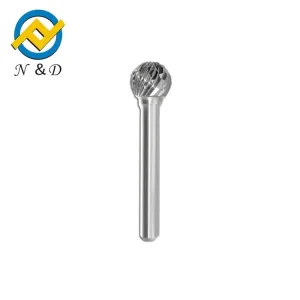
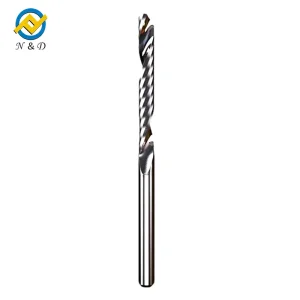
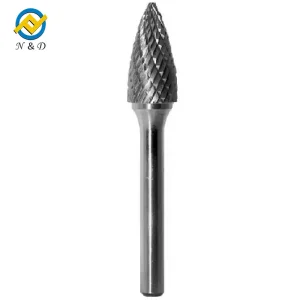
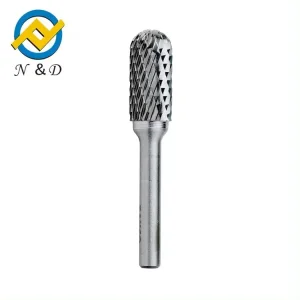
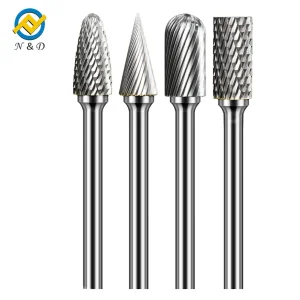
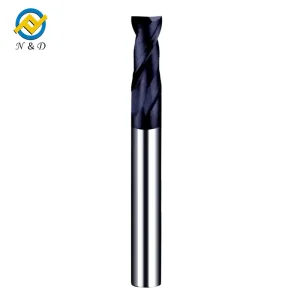
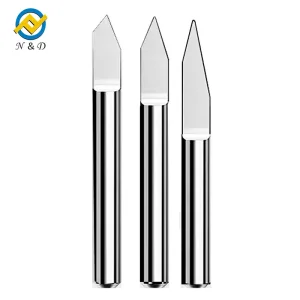
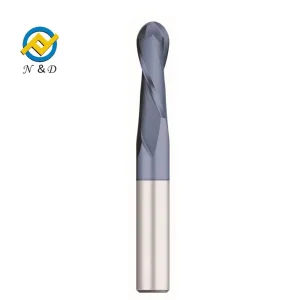
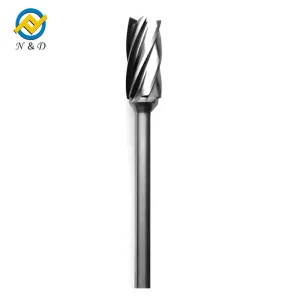
Left-hand end mills, often referred to as "down-cut" tools in the CNC industry, feature a reverse spiral flute geometry. Unlike standard right-hand tools that pull chips upward, these tools exert downward axial pressure. This is critical when machining thin sheets or composite materials that tend to lift or vibrate during the cutting process.
Our Left Hand End Mills utilize 0.6μm sub-micron tungsten carbide particles with a cobalt content ranging from 10% to 12%. This structural integrity ensures high hardness (HRA 92+) while maintaining the toughness necessary to resist the unique torsional stresses of reverse rotation.
By forcing chips downward, these mills protect the top surface of the workpiece from scratching. This makes them the "Gold Standard" for high-end signage, luxury electronics housing, and multilayer PCB routing where surface finish is non-negotiable.
In a market saturated with generic cutters, the N&D Advantage lies in our data-driven approach to geometry. We don't just sell tools; we provide a technical whitepaper depth of understanding. Left-hand mills are not merely "backwards tools"—they are stabilizers for modern high-speed machining centers where harmonic resonance can destroy a precision part in milliseconds.
Located in Guanghan, Sichuan Province, we are at the heart of China’s tungsten resource belt. This proximity allows for unprecedented cost stability even when global raw material prices fluctuate. We pass these savings directly to our global enterprise clients.
Our facility is ISO 9001:2015 certified. Every batch of Left Hand End Mills undergoes ultrasonic flaw detection and 5-axis laser inspection to ensure zero-defect delivery. We comply with REACH and RoHS standards for all European exports.
We provide localized technical support for enterprises in 60+ countries. Whether it's a specific coating for North American aerospace or custom shank tolerances for German automotive lines, our engineering team speaks the language of your industry.
As the industry moves towards Industry 4.0, the role of specialized cutting tools is evolving. Here is what we anticipate for the 2025-2030 horizon:
Using machine learning to simulate chip flow patterns, resulting in flute designs that reduce heat by 15%.
Transitioning from AlTiN to multi-layer Hi-PIMS coatings that extend tool life by 300% in hard-milling tasks.
Adopting lower-emission sintering processes to meet the ESG requirements of global Tier-1 manufacturers.
Rising demand for Left Hand Mills in sizes below 0.5mm for the wearable medical device industry.

We blend ultra-pure tungsten carbide with cobalt and rare earth elements in aviation gasoline to achieve a perfectly homogenous molecular structure.

Controlled evaporation of liquids to create high-flow powder granules, essential for uniform density in the pressing stage.

Advanced molding of the powder into "green" blanks using 300MPa of pressure to eliminate internal voids.

Over-pressure sintering at 1450°C transforms the blank into a near-diamond-hard solid carbide rod.

Using ANCA or Walter CNC machines to grind the left-hand flute geometry with micron-level precision.

Comprehensive 100% inspection of tooth profile, run-out, and finish using AI-assisted imaging systems.
Perfect for machining carbon fiber reinforced polymers (CFRP) where delamination is a risk. The down-cut action keeps layers compressed.
Used by global smartphone manufacturers for milling fragile display glass housings and thin aluminum frames without deformation.
Clean cutting of PEEK and surgical-grade polymers where burrs or surface melting can lead to component failure.
 N&D Carbide