The Definitive Industrial Guide to Premium Tungsten Carbide Tooling, Structural Customization, and Global Sourcing Economics
Direct factory solutions engineered for high durability, ultra-low friction, and supreme dimensional accuracy across diverse metallic substrates.
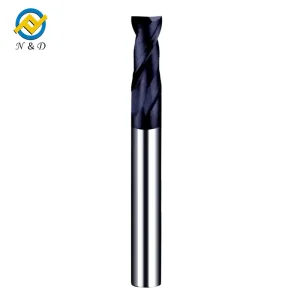
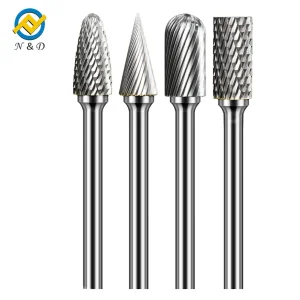
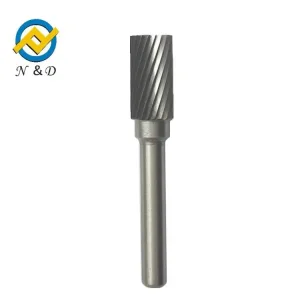
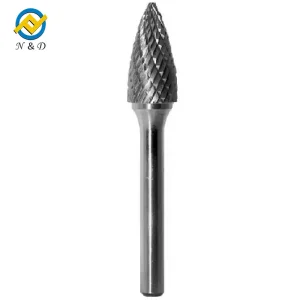
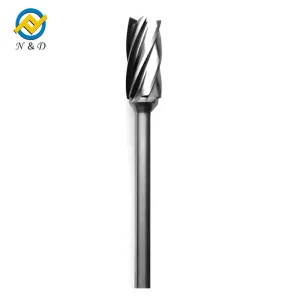
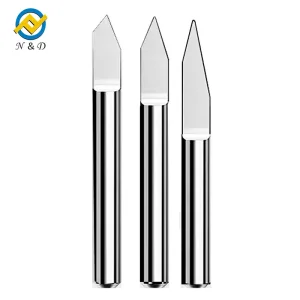
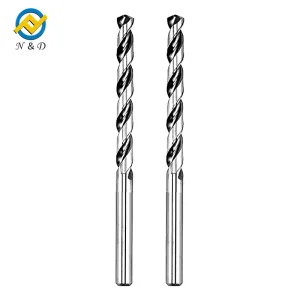
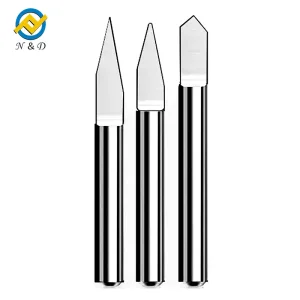
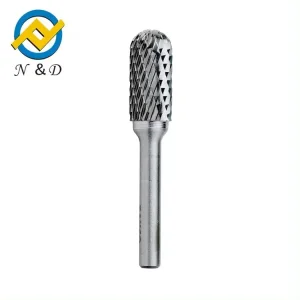
In rotary milling and deburring, geometry determines efficiency. The Double Cut Rotary Burr Set is designed with both left- and right-hand spiral flutes. These intersecting paths create small, chisel-like cutting teeth. Unlike single-cut alternatives that produce long, sharp ribbon-like chips, double-cut tools break down raw stock into fine, easily managed granules. This design reduces chip packing in the flutes, minimizing heat build-up and preventing premature tool failure.
From a metallurgical perspective, our burrs are made from premium-grade tungsten carbide ($WC$) with a cobalt ($Co$) binder system. Standard formulations use a grain size of 0.8–1.0 microns, balancing hard metal durability with thermal shock resistance. When operating at speeds from 15,000 to 50,000 RPM, the micro-grain matrix maintains sharp cutting edges even on difficult materials like stainless steels, aerospace titanium alloys, and high-nickel superalloys.
Selecting the correct burr shape is essential for proper tool path design and finish quality. Below is the standard classification system used by global procurement professionals for specifying Double Cut Rotary Burrs:
| Industry Type | Geometric Profile | Primary Application Areas | Standard Head Diameters |
|---|---|---|---|
| Type A | Cylinder (No End Cut) | Flat surface cleanup, sharp edge contouring, interior right-angle profiling. | 3mm, 6mm, 10mm, 12mm, 16mm |
| Type C | Cylinder (Ball Nose) | Fillet weld grinding, contour machining, internal radius blending in molds. | 6mm, 8mm, 10mm, 12mm, 19mm |
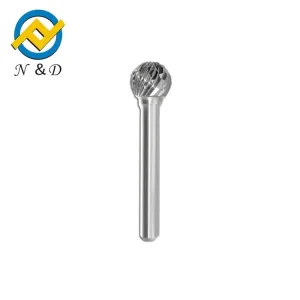
| Type D | Ball / Spherical | Pocketing, undercutting, engraving, internal radius shaping. | 3mm, 6mm, 12mm, 16mm |
| Type E | Oval / Egg Shape | Rounding shoulders, blending contours, intricate die pocket cleanup. | 6mm, 10mm, 12mm, 16mm |
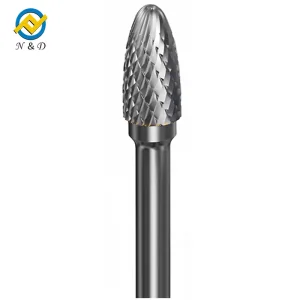
| Type F | Tree (Ball Nose) | Accessing narrow contours, radius blending in aerospace casing repairs. | 6mm, 10mm, 12mm, 16mm |
| Type G | Tree (Pointed Nose) | V-groove weld preparation, chamfering narrow channels, carving sharp interior corners. | 3mm, 6mm, 12mm, 16mm |
In addition to shape selection, the interface between the tungsten carbide head and the steel shank is critical. Utilizing advanced induction silver brazing technology, our assembly process ensures that joint shear strength exceeds 350 MPa. This construction prevents head separation under heavy side loads or high heat during extended operations.
Founded in 2004, our production facility in Guanghan, Sichuan Province, China, has pioneered tungsten carbide innovations for over two decades. Sichuan stands at the center of China’s natural gas and tungsten mining resources. This gives our metallurgical plants access to high-purity raw materials and stable, clean energy.
Our facility handles the entire production process under one roof. We oversee every step, from wet grinding and spray drying of raw tungsten carbide powder to automated uniaxial dry pressing, vacuum sinter-HIP (Hot Isostatic Pressing), and final CNC grinding. With over 120 dedicated operators and engineers, our Sichuan plant ships high-quality precision cutting tools to customers in over 60 countries.

How raw materials are refined into industrial-grade, precision-ground double cut rotary burrs.
Tungsten powder, cobalt binder, and paraffin are combined with processing solvents in ball mills. This ensures a uniform particle distribution.
The wet slurry is sprayed into a nitrogen-shielded drying chamber, converting it into free-flowing spherical granules with optimal pressing density.
High uniaxial pressure molds the loose carbide powders into solid blanks. This step produces green compacts near the target shape.
Using a vacuum furnace at 1450°C and 100 bar pressure, the green compacts shrink and consolidate. This removes internal micro-voids.
Modern 5-axis CNC grinding machines grind the double-cut geometry onto the sintered carbide heads with high dimensional precision.
Every burr undergoes geometric inspection via optical measuring machines and ultrasonic non-destructive testing for micro-fissures.
Helping global brands build value through competitive production costs and robust engineering solutions.
With access to major regional tungsten deposits and deep technical expertise, we control product consistency from raw powder to final geometry.
Our sinter-HIP processes combine high temperatures with intense gas pressure. This eliminates internal porosity and micro-cracks, extending service life by up to 200%.
Direct factory sourcing bypasses middleman markups. We pass these savings directly to our clients through competitive prices on custom orders and large volume runs.
In today's complex supply chains, managing procurement risk is crucial for industrial purchasing managers. When sourcing a double cut rotary burr set, assessing total cost of ownership (TCO) involves looking beyond the initial piece price. A low-cost burr that fails prematurely, dulls quickly, or causes shank slippage increases cycle times and can lead to costly rework in aerospace or shipyard applications.
For large-scale industrial operations, we recommend looking for manufacturers that provide detailed verification of raw materials, process tolerances, and quality certifications. Using five-axis CNC grinders for flute cutting helps prevent variations in geometry that can lead to unbalanced tool wear, high operator fatigue, and inconsistent surface finishes.
Sourcing strategies are also shifting toward custom solutions. For example, extended shank burrs (up to 150mm or 300mm) are increasingly needed for hard-to-reach pockets in heavy machinery assembly. Our engineers work with procurement teams to customize shank dimensions, head geometries, and functional coatings (like TiAlN for high-heat alloys) to improve overall tool life and efficiency.
Expert answers regarding speeds, feeds, material compatibility, and global procurement procedures.
Recommended operating speeds typically range from 15,000 to 50,000 RPM, depending on the tool diameter and material hardness. For larger burr diameters, run at the lower end of the speed range to prevent overheating. It is important to apply light, continuous pressure and keep the tool moving to avoid deep grooving and premature wear.
Single-cut burrs feature a single right-hand spiral flute, ideal for heavy material removal on soft, non-ferrous metals and plastics. Double-cut burrs add a crossing left-hand flute that breaks chips into small, manageable pieces. This reduces vibration, provides cleaner finishes, and offers better control when working with hard ferrous alloys and stainless steel.
We provide full OEM and ODM services. Customizations include non-standard shank lengths up to 300mm, targeted geometric adjustments, custom flute designs, laser branding, and specialized wear coatings like TiN, TiAlN, or AlTiN to match specific application needs.
To provide an accurate quote, please specify the desired shapes (Types A through M), head diameters, shank styles (1/4", 6mm, or 1/8"), expected order volume, packing preferences, and target delivery locations. Our team generally responds with a detailed quotation within 24 business hours.
Providing high-grade structural integrity, sharp cutting edges, and wear resistance for demanding industrial processes.
 N&D Carbide