 N&D Carbide
The Next-Generation Paradigm in Hard Metal Machining
A technical framework detailing structural compositions, nano-coatings, and future roadmaps of custom tungsten milling cutters.
As the global manufacturing domain progresses toward ultra-precision, the requirements placed on cutting tool integrity are experiencing exponential shifts. Sub-micron precision, dynamic tool longevity, and performance under extreme thermal conditions represent the baseline criteria for modern CNC machining operations. Custom Tungsten Milling Cutters have established themselves as an indispensable core within these configurations, transitioning from basic hardware to high-end engineered systems.
1. Global Industrial Landscape & Market Macro-Trends
The international manufacturing landscape is undergoing structural changes driven by electrification, lightweighting, and automated tool management systems. In automotive sectors, the machining of lightweight aluminum-silicon alloys and high-entropy structural castings has placed distinct demands on tool wear paths. Similarly, in high-thrust aerospace propulsion units, components constructed from nickel-iron-based superalloys (such as Inconel 718) demand cutting tools characterized by elevated thermal load limits and minimized edge degradation.
Current market projections indicate a sustained expansion in the demand for customized tungsten end mills and rotary tools, especially across advanced manufacturing centers in North America, Western Europe, and East Asia. Key growth drivers include:
- High-Speed Machining (HSM): Requiring balanced radial run-out configurations to mitigate harmonic resonance during operations exceeding 30,000 RPM.
- Near-Dry and Dry Machining: Placing structural focus on the thermal insulation capabilities of the cutter's nano-coating layers rather than relying on external liquid cooling systems.
- Intelligent Supply Chains: Elevating the value of regional, high-capacity factories capable of providing fast lead times on modified-standard profiles and customized shank designs.
Aerospace Structural Elements
Demands custom-fluted, variable-helix geometries to safely clear continuous, high-volume chip formations of Ti-6Al-4V while preserving surface integrity.
Automotive Powertrain Alloys
Prioritizes wear-resistant micro-grain carbide substrates optimized to handle cyclic abrasion from high-silicon aluminum and nodular cast iron housings.
High-Precision Die & Mold
Relies on micro-diameter ball nose cutters with surface roughness tolerances down to Ra 0.1 for complex 3D profiles in hardened tool steel (HRC 55-68).
2. Engineering & Metallurgy: Substrate Composition & Micro-Structures
The core performance of a premium tungsten milling cutter is rooted in its fundamental metallurgical composition. At our state-of-the-art facilities in Guanghan, Sichuan Province, the carbide substrate formulation is adjusted based on specific application classes (ISO P, K, M, S, H). A typical solid carbide end mill comprises 88-92% tungsten carbide (WC) micro-grains consolidated with a 8-12% cobalt (Co) binder matrix.
For advanced high-speed cutting applications, we employ ultra-fine and nano-grain structures (average grain sizes ranging from 0.2µm to 0.5µm). The reduction in grain boundaries within the sintered tool body yields a significant increase in transverse rupture strength (TRS) alongside high Vickers hardness numbers (up to 1850 HV30). This allows the cutting edge to resist chipping when subjected to high frequency shocks during intermittent milling operations.
Advanced Multi-Layer Coating Systems
Uncoated carbide is susceptible to rapid chemical degradation and oxidation at high cutting temperatures. To mitigate this, our custom cutters are treated with optimized Physical Vapor Deposition (PVD) coatings:
- AlTiN (Aluminum Titanium Nitride): Features high oxidation resistance up to 900°C. Ideal for structural dry machining of carbon steels and general components.
- TiAlSiN (Titanium Aluminum Silicon Nitride): Incorporates silicon to form an amorphous silica barrier, providing micro-hardness up to 38 GPa. Highly effective for milling hardened steel alloys up to HRC 65.
- DLC (Diamond-Like Carbon): Features a low friction coefficient (less than 0.1) and high hardness. Engineered for milling non-ferrous materials such as aluminum, copper, and structural composites, eliminating material adhesion at the cutting edge.
3. Micro-Geometry Engineering & Rake Angle Design
The geometrical profile of the flute represents the critical boundary where material removal is executed. Standard tools often suffer from harmonic vibration and uneven wear patterns under high feed rates. Customization of this geometry is essential for maintaining process stability:
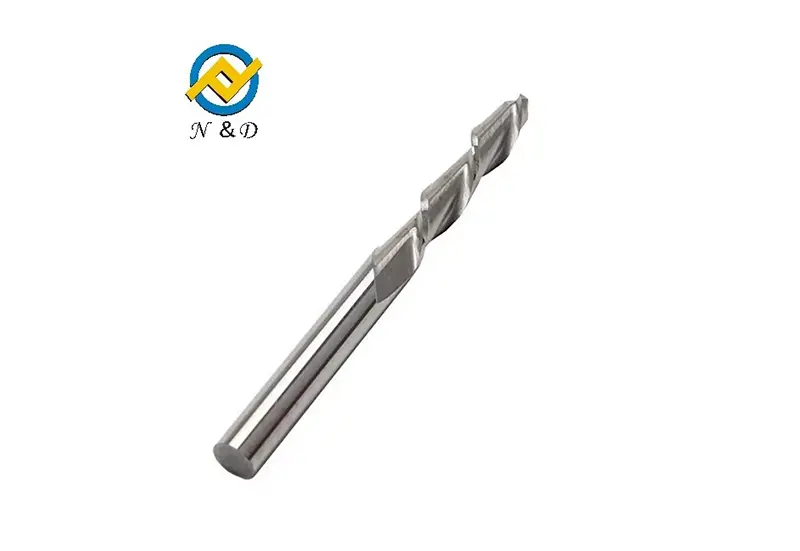
Variable Helix Angle (e.g., 35°/38°)
Breaks up uniform impact frequencies during tool rotation, suppressing chatter in heavy-duty slotting operations and roughing passes.
Unequal Pitch Flute Spacing
Disrupts harmonic synchronization across the cutter, improving chip-clearance capacity and maximizing material removal rates (MRR).
Edge Preparation (Honing vs. Chamfering)
Applying controlled micro-honing (radius ranging from 5µm to 15µm) strengthens the cutting edge, reducing premature chipping under cyclic loads.