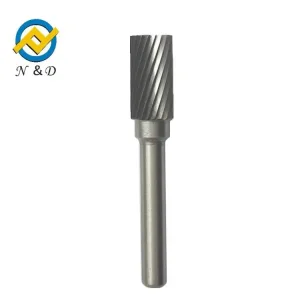
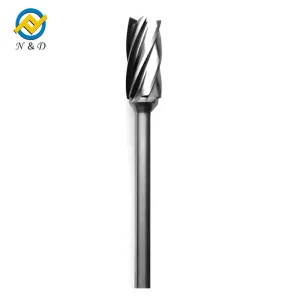
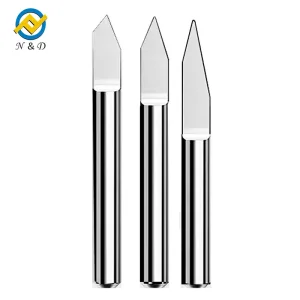
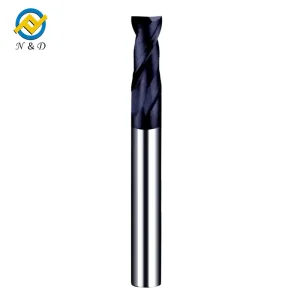
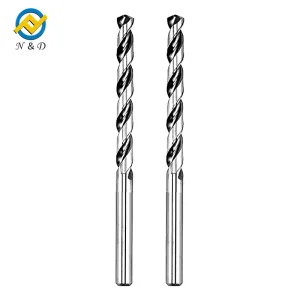
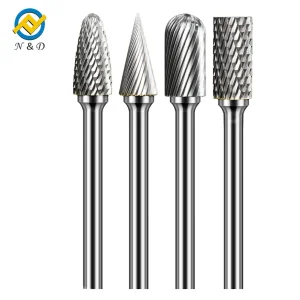
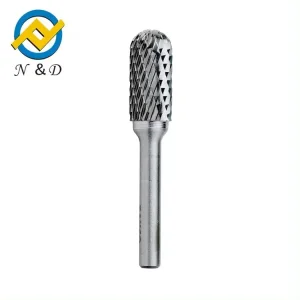
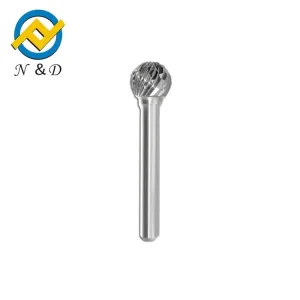
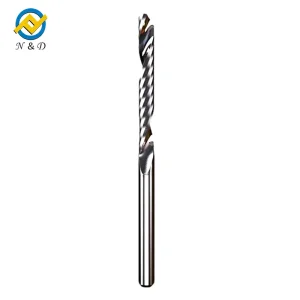
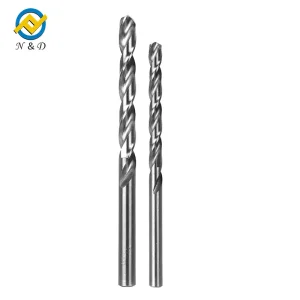
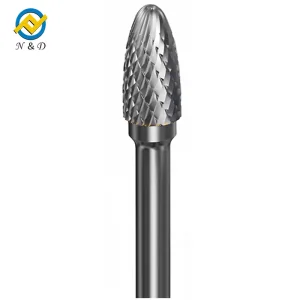
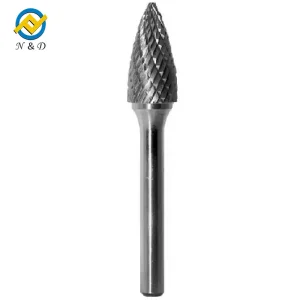
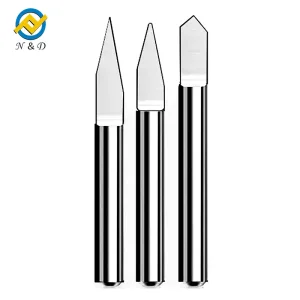
Discover our initial selection of high-hardness rotary tools, twist drills, and specialty end mills designed for structural integrity and high chip evacuation speeds.
In high-speed precision manufacturing, the geometry of the cutting edge directly impacts component structural integrity and surface micro-topography. Carbide Concave Radius End Mills—also known as corner-rounding end mills—are specialized rotary cutting tools engineered to profile external radiused corners. Unlike standard ball-nose end mills that execute 3D contouring processes in concentric layers, concave radius cutters mill a uniform, precisely engineered radius along an edge in a single, efficient linear feed stroke. This reduces operational cycles significantly, while ensuring micro-geometric surface regularity.
The operational physics of concave contouring involves complex multi-axis shear angles. As the radius curves inward toward the tool shank, the peripheral cutting speed (cutting velocity, Vc) varies dynamically across the cutting edge. To maintain stable chip thickness and prevent work hardening of hard-to-machine alloys (such as Titanium Ti-6Al-4V, Inconel 718, or custom aerospace stainless steels), the grain structural density of the tungsten carbide matrix must withstand massive mechanical and thermal stresses. Premium factories utilize sub-micron (grain size 0.4μm to 0.7μm) and nano-grain (grain size <0.2μm) tungsten carbide matrices, balanced with a cobalt binder ratio of 8% to 12% to achieve an optimal trade-off between extreme hardness (typically 92 to 94 HRA) and superior transverse rupture strength (TRS ≥ 4000 N/mm²).
Runout (Total Indicated Runout, or T.I.R.) is the silent failure mode of ultra-precision concave profiling. Because a concave radius tool makes multi-point contact simultaneously as it straddles a corner, any microscopic axial deviation will cause uneven chip load distribution. This leads to cyclic vibration, micro-chipping along the cutting lip, and an uneven finished profile with detectable "scallop lines." By keeping our concentricity tolerance under 0.005mm (5 microns), N&D tool engineering prevents premature tool failure and delivers mirror-like finishes (Ra ≤ 0.2 μm) in CNC metalworking applications.
Our industrial concave end mills are custom engineered to handle demanding feed paths. Here is how our geometrical and coating specifications set a new benchmark for information gain and machining productivity.
Multi-flute options custom-designed for different structural substrates and CNC machining styles.
Varied helix strategies to disrupt structural harmonics and suppress chatter in deep cavity milling.
Sub-micron thin film coatings deposited in high-vacuum physical vapor systems for thermal barrier security.
Our industrial facility in Guanghan, Sichuan, leverage direct structural access to high-grade raw tungsten materials and cutting-edge grinding technology.
China is home to over 80% of the world's natural tungsten ore reserves, concentrated deeply in southwestern and southern geological formations. By placing our primary production plant in Guanghan, Sichuan, N&D Tungsten Carbide eliminates the supply uncertainties and high freight surcharges associated with intermediate trading routes. We process direct high-purity Ammonium Paratungstate (APT) raw inputs directly into tungsten carbide powders within short localized distances.
This upstream mineral integration, coupled with the lower operational utility and labor costs of Sichuan province, allows us to pass massive cost savings down to international buyers. Furthermore, our investment in high-precision automated machinery ensures that while our cost remains highly competitive, our geometric tolerances meet the most stringent Western standards.

From sub-micron powder preparation to multi-axis CNC grinding, our rigorous quality control procedures are certified under ISO 9001:2015 frameworks.


Enterprise procurement departments managing supply pipelines face structural market risks: volatile tool wear rates, delivery delays from customs mismatches, compliance failure, and lack of localized application engineering. N&D Tungsten Carbide resolves these common industry bottlenecks through transparent regulatory compliance and structured localization policies.
Compliance & Chemical Safety (REACH / RoHS): Our raw carbide material streams are fully certified as trace-free of conflict minerals, complying fully with the Dodd-Frank Act (3TG sourcing). Every batch of concave end mills exported to North America and Europe comes accompanied by REACH chemical registration documents and RoHS compliance sheets, ensuring seamless clearance through international customs frameworks.
Standardization (DIN vs. ANSI): Rather than relying on non-standardized tool templates, N&D manufactures concave end mills strictly matching European DIN standards (such as DIN 6535 HA/HB/HE shanks) and American ANSI specifications. This ensures full physical compatibility with modern toolholders (Schunk, Haimer, Rego-Fix) without runout amplification.
To demonstrate absolute professional expertise, here are actual mechanical conditions where our concave radius tools excel:
No two CNC machining lines are identical. We provide a fully collaborative engineering service that tailors tool geometry to your proprietary manufacturing constraints.
We match the specific mechanical properties of the workpiece to the carbide substrate's microstructural parameters.
For high-silicon aluminum, we supply K10-K20 substrates with ultra-fine grain profiles. For hardened steels (>60 HRC), we formulate customized ultra-tough sub-micron substrates with higher cobalt distributions to prevent corner chipping.
We provide full barcode, QR code, and technical data marking on tool shanks to enable modern factory automated sorting.
Our high-resolution laser marking systems etch precise radius details, part numbers, and batch lot identification, ensuring traceability across automated tool management systems (such as Matrix or ToolWall).
Send us your dynamic CAD files (STEP, DXF, or IGES), and our engineering team will optimize a tool profile within 48 hours.
Using highly accurate virtual simulation software, we verify clearance behavior before starting physical production on CNC grinding machines. This avoids costly prototype grinding trials.
Explore expert technical solutions regarding feed configurations, speeds, coatings, and toolpath strategies for external rounding operations.
For Titanium Alloys (such as Ti-6Al-4V), we recommend a starting cutting speed of 120 to 180 SFM (36 to 55 m/min) when utilizing an AlTiN PVD-coated tool. The feed per tooth (IPT) should be carefully configured based on the radius size: typically between 0.0008" and 0.002" (0.02mm to 0.05mm) per flute. To prevent severe work hardening, maintain a continuous feed rate and never allow the tool to dwell in the cut.
A variable helix angle (for example, combining 35-degree and 38-degree flutes) disrupts the uniform cutting frequency of the flutes as they contact the workpiece. In standard end mills, uniform frequencies amplify natural harmonics, leading to severe chatter marks on the workpiece and rapid edge breakdown. By varying the helix angle, vibrations are canceled out, enabling high feed rates and producing superior surface finishes (Ra < 0.4 microns).
Yes, solid carbide concave end mills can be successfully resharpened (reground). However, because the tool features a complex concave profile, resharpening must be conducted on a professional 5-axis CNC grinding machine utilizing identical CAD models. Grind the face of the flute (the rake face) rather than the outer diameter relief to prevent changes in the precise outer radius dimension. After regrinding, re-coating the tool with PVD films is highly recommended to restore original tool wear resistance.
To eliminate burr formation when profiling aluminum alloys (like 6061-T6): 1) Utilize a highly polished 2-flute concave end mill coated with DLC (Diamond-Like Carbon) to prevent material welding (Built-Up Edge). 2) Program a climb-milling (down-milling) toolpath instead of conventional up-milling. 3) Apply high-pressure flood coolant or mist cooling directly at the shear zone to efficiently flush chips and reduce friction-induced temperatures.
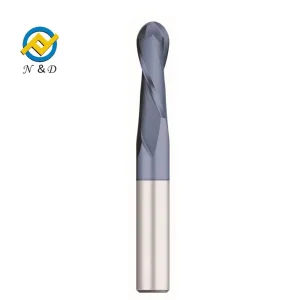
Select from our extended inventory of custom-dimensioned ball-nose end mills, single flute spiral cutters, and high-performance twist drills.
 N&D Carbide