Choosing a Tungsten Carbide Twist Drill is not just a matter of selecting the hardest tool. The right choice depends on the workpiece, hole depth, machine rigidity, coolant delivery, and required finish. A drill cutting stainless steel on a stable CNC machine faces different demands from one making deep holes in abrasive cast iron. Small details count.
Material supply also matters. The U.S. Geological Survey’s Mineral Commodity Summaries 2025 estimated global tungsten mine production at about 81,000 metric tons in 2024, with China accounting for most output. This figure describes the raw-material market, not drill quality or cutting performance. Still, it highlights why buyers should consider grade consistency, traceability, and reliable sourcing alongside price. The International Organization for Standardization’s ISO 513:2012 provides a recognized classification framework for hard cutting materials and their applications. It can help readers understand tool-material terminology, though it does not replace a manufacturer’s drilling recommendations.
This guide explains how to compare carbide grade, point geometry, coating, shank design, and flute length against real operating conditions. Look beyond a shiny coating or a low unit price. Check whether the drill suits your material and setup, then review speed, feed, and coolant guidance. There is no universal best drill. Even experienced machinists sometimes discover that a seemingly minor change—such as a shorter drill or better chip evacuation—makes the larger difference.
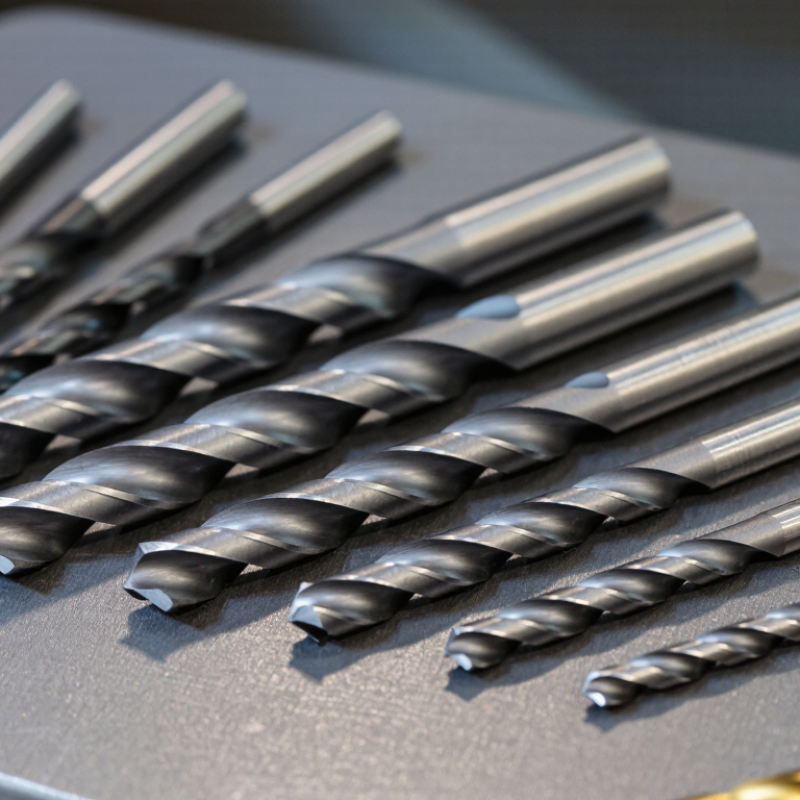
Understanding Tungsten Carbide Twist Drill Design and Materials
Tungsten carbide twist drills are made from cemented carbide, not solid tungsten. Hard carbide grains resist abrasion, while a metallic binder, often cobalt, helps hold them together. Grain size and binder content affect hardness and toughness: finer grains can support sharper edges, but a drill that is too brittle may chip when it meets a hard inclusion. There is a trade-off. The USGS Mineral Commodity Summaries 2024 estimated global tungsten mine production at about 78,000 metric tons in 2023. That figure describes raw material supply, not drill quality; tool performance still depends on grade, geometry, and manufacturing control.
The flute helix carries chips away from the cutting edge. A higher helix can help clear long chips in softer metals, while a sturdier core supports drilling harder materials. Point angle also matters: a split point can reduce wandering on a flat surface, but it is not a substitute for correct feed and alignment. For example, listen for a steady cutting sound and watch for smooth, short chips. The sound alone can mislead. It is worth checking the hole and tool edge, too.
Tips: Match the drill’s carbide grade and point geometry to the workpiece. Use rigid clamping, suitable coolant, and controlled feed. If the edge chips early, reconsider runout, setup, and cutting conditions before blaming the material.
Matching Drill Types to Workpiece Materials and Applications
How to Choose a Tungsten Carbide Twist Drill?
Matching the drill to the workpiece matters more than choosing the hardest tool. For hardened steel above 45 HRC, use a solid carbide twist drill with a rigid geometry and short cutting length. A 135-degree split point can reduce walking on a prepared surface. For cast iron, choose a strong web and wide flutes, because abrasive dust can quickly dull a fragile edge. Keep the drill dry only when the tooling supplier permits it.
Aluminum needs polished flutes and generous chip space. Otherwise, soft chips may weld around the tip. For glass-fiber composites, a carbide drill with controlled point geometry helps limit splintering at the exit. Carbide-tipped designs suit larger holes and less rigid machines, while solid carbide offers better accuracy under stable conditions. Runout should remain very low; even a small error can produce uneven edge loading.
The USGS Mineral Commodity Summaries 2024 estimated global tungsten mine production at 84,000 metric tons in 2023. Tungsten remains strategically important because carbide tools combine hardness with wear resistance. ISO 513 also separates cutting-tool materials by performance and application, reinforcing that no single carbide grade fits every workpiece. A hardness chart is not enough. Check machine rigidity, hole depth, coolant delivery, and chip shape during a short trial. I would not trust a perfect catalog match without inspecting the first hole. Tool life may disappoint when vibration, poor clamping, or interrupted cutting is ignored.
Selecting the Correct Drill Diameter, Length, and Point Geometry
Choosing a tungsten carbide twist drill starts with the hole diameter, not the tool catalog. Match the drill to the required finished size and tolerance. Carbide drills cut accurately, but runout can enlarge a small hole quickly. Check the machine spindle, collet, and workholding before blaming the diameter. A test hole in the same material is valuable. It also exposes assumptions.
Use the shortest drill that reaches the full hole depth. Excess length increases bending, vibration, and breakage risk. Stub-length tools usually provide better rigidity for shallow holes. Deeper holes may need longer flutes, but chip evacuation becomes more difficult. Peck drilling and suitable coolant can help. Do not force a long drill into a tight setup. That mistake is common.
Point geometry controls cutting pressure and entry behavior. A 118-degree point can suit general drilling, while a 135-degree split point often reduces walking and thrust. Hard, abrasive, or brittle materials may require a different point design and clearance angle. The best geometry depends on hardness, thickness, and machine stability. I once selected a point by material name alone, and the hole still chipped at the exit. The setup mattered more than expected. Review the entry and exit surfaces, then confirm the result with measurement rather than appearance.
Evaluating Cutting Conditions, Cooling, and Tool Compatibility
Choosing a tungsten carbide twist drill starts with the cutting conditions, not just the material label. Check the workpiece hardness, hole depth, and whether the surface is flat or angled. A hard, brittle drill needs a rigid setup; spindle runout or a loose workpiece can cause chipping before the cutting edge wears out. Keep the tool path steady. I treat speed and feed recommendations as a starting point, then adjust carefully for the actual machine and setup.
Cooling and tool compatibility matter just as much. Use a coolant method suited to the drill and machine, and make sure fluid reaches the cutting zone, especially in deeper holes. Poor chip evacuation can leave hot chips rubbing against the hole wall. That is easy to overlook. Confirm that the drill’s shank fits the holder securely, and check the holder, spindle, and workpiece for alignment. A small mismatch can produce vibration, oversized holes, or a damaged edge. I would inspect the first hole rather than assume the setup is perfect.
Tips: Clear chips before they pack in the flutes. Listen for a sudden change in cutting sound. If the drill chatters, stop and check rigidity, runout, and feed. Don’t keep pushing through a rough cut; the cause may be the setup, not the drill.
Checking Quality, Coatings, and Service Life Before Purchase
How to Choose a Tungsten Carbide Twist Drill?
Before purchasing, inspect the drill under bright light. The cutting edges should look sharp, even, and free from small chips. Check the flute surfaces for grinding marks, cracks, or uneven polishing. A straight shank matters too. Excessive runout can create oversized holes, vibration, and premature breakage. In practice, I measure runout with a dial indicator when hole accuracy is critical. A certificate helps, but it should not replace physical inspection.
Coatings affect heat control, friction, and service life. Choose a coating that matches the workpiece and cutting conditions. For abrasive alloys, a wear-resistant coating can protect the edge. For heat-sensitive operations, cooling and correct speed remain essential. A coating cannot repair poor alignment or excessive feed. I have sometimes trusted coating claims too quickly. Actual results depend on machine rigidity, coolant flow, and operator technique. Ask for test data, hardness information, and recommended cutting parameters before ordering.
Tips: Compare sample-hole quality, not only the advertised tool life. Count how many holes remain clean before edge wear appears. Store drills in separate sleeves to prevent edge contact. Use a microscope or strong magnifier after testing. Record spindle speed, feed rate, material grade, and hole depth. Service life may vary between batches, even when specifications appear identical. If a tool fails early, review the setup before blaming the drill.
How to Choose a Tungsten Carbide Twist Drill?
Typical substrate density ranges (g/cm³)
Cemented carbide is substantially denser than high-speed steel. These approximate ranges vary with grade and composition; density alone does not prove drill quality or predict service life. Before purchase, also check the cutting edges for symmetry and damage, the coating for consistent coverage, and the supplier’s runout and application guidance.
Conclusion
Choosing a Tungsten Carbide Twist Drill begins with understanding how its design and material properties affect strength, heat resistance, and cutting performance. Match the drill type to the workpiece and task, since different materials and applications can call for different flute designs and cutting characteristics. Then select a diameter, overall length, and point geometry suited to the required hole and the available setup, balancing access, accuracy, and stability.
Before purchasing, consider cutting speed, feed, cooling, and compatibility with the machine and holder. These conditions influence both drilling quality and tool wear. Check the drill’s manufacturing quality, coating suitability, and expected service life in relation to the intended workload. A well-matched tool can support consistent results and dependable operation while helping avoid unnecessary wear and replacement costs.

 N&D Carbide